
Experience sharing
Chan Meditation Center English Sunday Dharma Talk - The Heart of Chan: Exploring Mind via Mahaprajna Paramita -3 Talk By Gilbert Gutierrez
On October 4, 2020, Gilbert presented an omnibus view on Buddha dharma. Gilbert did not just give us a little flavor of different things. He explicated many extremely important and esoteric concepts of Mahayana in one and a half hours. He showed us the key to the door of realization(s). After a thorough study of this lecture, I feel as though I have been awarded the three Jewels: the Buddha, the Dharma, and the Sangha. I learned that proper contemplation leads one’s mind to lose its delusion so that one sees things as they are arising. I learned that the fog trapped in the mountain will clear as one practices with the right effort, contemplates with the right view, and keeps sharpening the present moment to the pin point. I encourage all my fellow Chan practitioners to re-listen and contemplate this dharma lecture presented by Gilbert. Below is a reflection report/summary of this lecture to the best of my understanding.
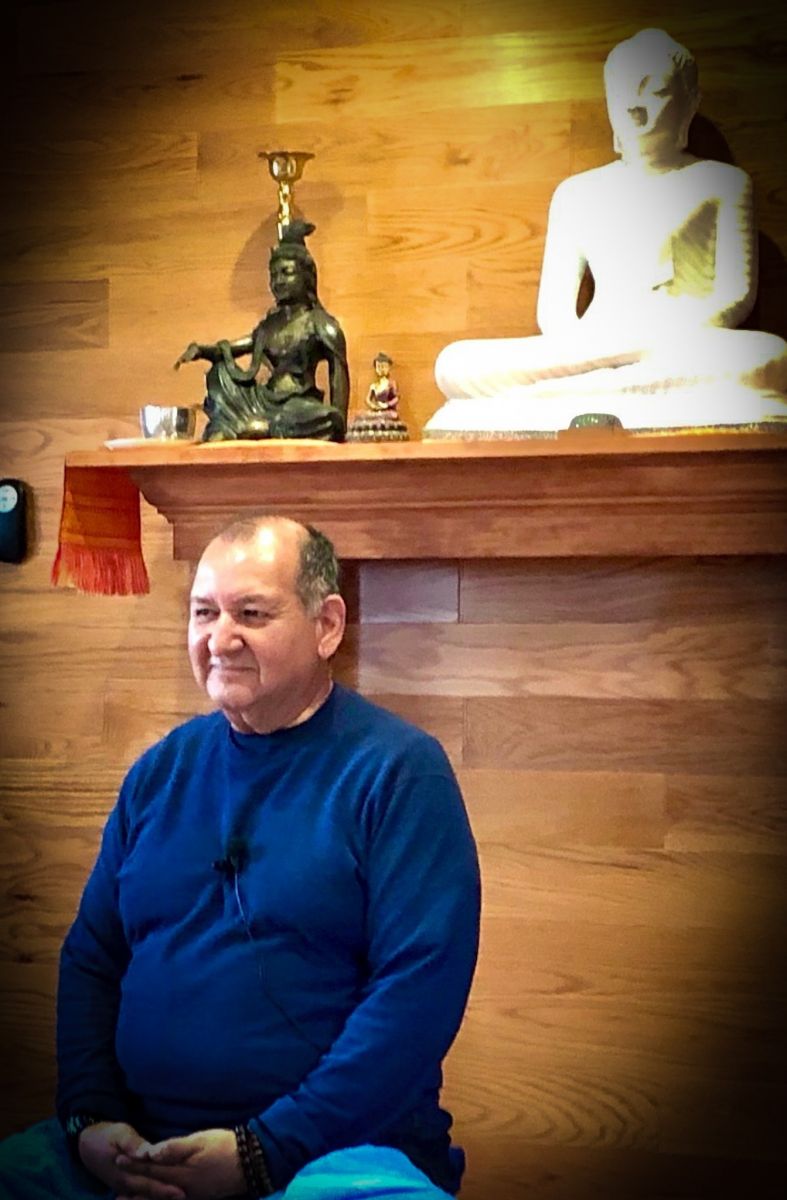 Gilbert presented three main topics in this dharma lecture: (I) The history of Buddhism: the development of the Buddhist canon in India during the period 500-100 BCE, how the Buddhist canon spread to central Asia during the Kushan Empire, and eventually how it crossed the Silk Route and populated China and east Asia during the period 100 BCE-600 CE. (II). The doctrines of Buddhism, including Agama, Vinaya and Abhidhama texts from the early Buddhist schools as well as the Mahayana Sutras and scriptures from Esoteric Buddhism; and (III) the Essence of the practice in Buddhism. Because Gilbert’s responses to the three excellent questions are profound, clear, and exceptionally helpful, I also add section IV Q&A at the end.
I. The History of Buddhism – From India Buddhism to Sinification of the Buddha Dharma:
Most of us know that all Buddhist scriptures were written after the Buddha’s Parinirvana. Gilbert recounted that Buddhism originated from India in 500 BCE. However, 250 years after the Buddha’s passing (250 BCE to 100 BCE), there were lot of writings on Buddha dharma in India. These dharma writings were in Sanskrit, Pali, or other Indian languages, which were trickling slowly northeast via the hot bath of Buddhism at that time, the Kushan Empire, then through the Silk Route and finally reaching China between 100 CE - 500 CE, or as late as 600 CE. As the Buddha dharma came to China in spurts and in pieces over a span of 1000 years, the lag time, however, gave the Chinese a chance to be able to process this information even though it was written 200 or 300 years before.
The Buddha dharmas which were brought to China range from the earlier Theravada writings to a great varieties of Mahayana writings. The Theravada School were saying that everything is real. Theravada means the studies of elders. Their main doctrine besides Nakaya was the Abhidharma. Abhi means higher, the highest dharma. Their big leaguers were Sariputra and Vasabandhu who wrote commentaries on Abhidharma and supported it.
Mahayana includes the Madhymica School and the Yogacara School. The Madhymica School came before the Yogacara School and was founded by an Indian philosopher, Nagarjuna. The Madhymica School holds the emptiness doctrine and the no svabhava (intrinsic nature) doctrine. The Yogacara School is also known as a Consciousness Only School. They say that everything is empty and that everything is just consciousness. Sometimes they say mere consciousness, which is different from saying that everything is real. The two brothers Asonga (無著) and Vasabandhu (世親, the 21st Patriarch) were in the Yogacara School, and both had written commentaries on the Yogacara School. Gilbert clarified that Vasabandhu initially was a Theravadan and had written commentaries on Abhidharma and supported it, but he changed his mind after he was exposed to Mahayana teachings
When Buddhism came in, it said it’s empty. At that point, the Chinese already had established their own indigenous belief systems of Confucianism and Daoism, and ultimately, Neo-Confucianism, where the Confucianism talks about the ideal of people, and Daoism talks about the ideal of immortality. They tried to merge the two together to get something from that. However, as Gilbert noted, it wasn’t something that did cause damage to Chinese’s indigenous systems. What it did was it produced a hybrid of Buddha dharma in a way that was translated and interpreted by the Chinese culture. That’s what was called the Sinification of the Buddha dharma. It did not change the fundamental of Buddhism, it just interpreted that what was there.
As a result, from the Madhymica School it came the Wei Shi School. “Cheng Weishi Lun (成唯識論)” was the Chinese product of the Yogacara School, which in turn, created the Hua Yan, Tian Tai, and Chan Schools in China. The Hua Yan and Tian Tai Schools are very scholarly in terms of how they approached the Buddha dharma and they did have their meditation system. The Chan School took a quiet approach and emphasized sitting meditation, without it deviating from the doctrines. The Yogacara School also generated the Tibetan Vajnayana School in China.
After 600 CE, the Chinese Chan School had a heavy reliance on Ekayana, which means one mind or just mind. Gilbert pointed out that Ekayana has been taught from the beginning by Bodhidharma and continued on through the Six Patriarch. The concept of just mind and observing it was influenced by the Thathagatagarbha Sutras that talks about the Buddha nature. There was a chain of sutras addressing the idea of just emptiness, including the Queen Srimala Sutra, the Ratnagotravibhāga Sutra, the Vimalakirti Sutra and the Thathagatagarbha Sutra. Although Nagarjuna introduced the concept of emptiness, he did not talk about it; rather he advised people to see it for themselves through sincere practice. Gilbert noted that this is the emphasis of Chan on sitting which leads to Mo Zhao, just sitting. But just sitting is not enough. Gilbert advises that we turn off the switch of all six sensory gates as if we were some kind of robot. We just turn it off because there is no production of wisdom in that. Same thing with Hua Tou, before the word. When one applies the Hua Tou before the word, one is putting the mind back and restoring it to where it should be, which is before the word.
We find that there was great care involved during the entire process of collecting and summarizing what the Buddha had taught back in India, through the transmission, translation, and interpretation of the Buddha dharma. It was a great battle, a great interpretation, a great fight about what the practice has been from the very beginning, from the first council to the second council where there was split back in India of the monastic orders. There was always an interpretation. People would say this was what the Buddha taught. This could be very suspect because how can anybody write down 250 or 300 years after the Buddha passed away and sweared that those were the exact words of that the Buddha taught. Nonetheless, one thing that we can be sure of is that what we practice is what the Buddha taught. What did the Buddha teach? The Buddha taught dhyana, i.e., practice. Gilbert emphasized that the word Mahayana means the supreme practice.
II. The Doctrine of Buddhism – Yogacara School and Chan School
Gilbert noted that the Buddha did not specifically say Anatman, “no self,” but what he said was “not self.” Everything in Buddhism all the way through from Theravada to Thathagatagarbha, it is talking about not self. Yogacara School says that in terms of consciousness everything is just the self-nature of mind. The Thathagatagarbha Sutra went on to explain how the self-nature of mind functions via the mind perception, which is totally different. The idea is that there isn’t this life in me. It began with the Prajnaparamita Sutra, all of these studies that are happening, things that are going on here, whether it’s Madhyamika School, which gave essentially birth to the Yogacara School and Chan School. When we look at all the different sutras that are there, all those sutras are pointing to this Ekayana, this one mind but not with a nature of duality, that with something that’s not mind. Just simply saying it’s not self. It’s not that. It’s just suchness. The Thathagatagarbha Sutras are a formulation of all that had gone on before. Now to us we are looking at all of these sutras, and we are seeing them in these spans of time. We are looking back, and we have to see how it developed.
Gilbert used Yogacara School as an example to illustrate where they are coming from with this Consciousness Only School, which talks about mere consciousness. In the 4th century CE, Asonga and Vasabandhu began to make their commentaries on this, and this is where Vasabandhu had to abandon the Abhidharma that everything is real.
To explain a Sanskrit term ”Vijnapatimatrata” (i.e., A Demonstration of the Consciousness-Only Thesis), Gilbert cited to the Sandhinirmocana Sutra (解深密經), where a question to the Buddha is quoted: “Whether the images or replicas which are the object of the meditative concentration are different or separate.” Here it says “Are these different or separate from the mind? When one is meditating, and one sees something flying through the mind, is that something real or not real? Is that something separate from that which is perceiving it?
Gilbert indicated that we have to look at how mind works, not just this consciousness. He used an enchilada analogy. When we talk about enchiladas, we meant the whole enchilada which contains everything in it. He then quoted a Vasabandhu’s comment:”This world manifested itself as an unreal object, just like the case of those with cataracts seeing a real hare in the moon and the like.“ To which another scholar commented that “What Vasabandhu means here is only that we are aware of this mental image or impressions which manifests themselves.as external objects. But there is actually no such thing outside the mind.” Because all of these appearances are within mind, there is no corresponding thing or object, just as in the dream they appeared even without a thing or object. Therefore, these representations are mere representations. This is Vijnapatimatrata. This is also why the Yogacara school is often refer to as a Mind Only School or mere consciousness school.
Gilbert further explained the role of the 8th consciousness (alayavijnana). The 8th consciousness was created by the Yogacara School so that there is something other than the 7th consciousness where memory and actions can be stored. They used this 8th consciousness, which is essentially always there, and it is just mind itself. As a person began to practice through the consciousness, through the five sensory consciousness, the 6th consciousness puts together and aggregates the first five consciousness, and the 7th consciousness performs judging, discriminating, reacting to it via the five skandhas. When one sees that all of that seemed to be unreal, all of that collapses. As it collapses, what’s left is the 8th consciousness, which, according to Gilbert, cannot be called the 8th consciousness at that point. Rather, it’s just is what it is. It’s just mere consciousness.
Gilbert also mentioned the book “The Treatise on Awakening of Faith in the Mahayana,”
which is attributed to an Indian scholar, Asvaghosha (馬鳴大士, the 12th Patriarch). Although there is no Indian Sanskrit text remaining, some scholars, such as Suzuki, accepted it as Sanskrit origin. The Awakening of Faith is said to be translated by Paramatha and a group of scholars. Together, they have translated tremendous numbers of scriptures, including some of the major sutras such as Abhidharmmakosa, into Chinese. Paramatha, along with Kumarajiva and Xuanzang, are considered as some of the greatest translators of Buddhist sutras.
Gilbert stressed the importance of faith in the Mahayana. He pointed out that one cannot just discuss the awakening of the absolute reality without discussing the faith. He explained that the faith addressed in Mahayana refers to the “style” which is the “true suchness” of mind. This is what we look at in realization. This is how we get the deep faith of Mahayana when we are in accord with “Ekayana.” This is also what the Lotus Sutra, the Lankavatara Sutra, the Avatamsaka Sutra, and the Mahaparinirvana Sutra talk about. Gilbert further noted that Ekayana comes from Mahayana regarding apparent reality vs. absolute reality. Nakajuna said that everything is empty. It is worthy of exploring. The Lotus Sutra and the Yogacara School follow it stating that everything is the self-nature of the mind. The Chan School follows it. They appear that they stand alone. However, all of them is Mahayana nature. The Thathagatagarbha Sutra perfects it by pointing out that everything is the self-nature of mind and it has no self. It is just the suchness. That’s why they used the word Thathagata or Thatha-a-gata, i.e., Thus Come One, and Thus Gone One.”
In the Yogacara School, there are three natures of phenomena (Trisvabhava 三自性) by which the followers of the Mind Only School divide all phenomena into three categories.
1. Parikalpita-Svabhava (遍計所執性)-
It literally means “fully conceptualized” nature, which is what most people work around. Everything they see or touch is conceptualized: I think, therefore, I am; I see things and therefore they exist. Everything is there so it’s a fully loaded state of delusion and ignorance. They are not aware of how things arise. They may even create a god to say, “Okay, it’s God’s will in everything that happens around us and so I am subject to this.” When they are in this state of an imaginary constructed nature, they cannot make any progress, because this is subject-object dualism.
2. Paratantra-Svabhava (依他起性)
In this part, everything is seen as dependent origination nature of dharmas or causal flows. This is the twelve nidanas. This is how things happen. As we are seeing this, we see that there is absence of existence of nature in conditions that arise and perish. In this way, what we are seeing is how it works. Gilbert called it a “level acquired dharma,” where a practitioner practiced and looked into things. As we began to practice this, we saw things and began to contemplate, we ultimately could be in a state of contemplation. Gilbert described an experience of Mahabouwa’s disciple from the forest tradition, where the disciple was caught up in this beautiful wonderful brilliance of light at the progression of the meditation at the very end, and the disciple thought that it was an enlightenment experience, but Mahabouwa negated it. He said that is the luminous nature, this is the radiance of mind, but still there is a fundamental ignorance of the self there, i.e., something is observing that.” Thus, Gilbert concluded that “at this stage, even in the Yogacara School interpret the same way, that it doesn’t get you all the way there.
3. Parinispanna- Svabhava (圓成實性): It is “fully accomplished,” or consummated nature or
true nature of things, so this is the suchness of things. It’s gone beyond all conception and all understanding of conceptions. You cannot sit there and say,” Oh! This is so great. I understand now,” because mind is revealing itself to you. At this point, there is no discrimination; there is just an appearance of radiance of mind, but one is still looking at it and superimposes one’s perceptions onto the mind. We cannot see this very thin layer of self that superimposed onto it. We have to break through that. Many people stop there and say, “Oh, I got it, I am enlightened.” No, it isn’t in this way. They haven’t gone through, they haven’t finished.
III. The Essence of Practice
Gilbert emphasized that it requires Mahayana, the supreme practice to break through that.
Why? As mentioned above, the Buddha taught dhyana, practice. The word Mahayana also means the supreme practice. It is this supreme practice that takes us there. Why? If one is just listening without practicing, one is practicing what Sravokas did. Thus, one has to put it into practice in a great effort and in great sincerity. One has to make this one’s own. How does one do this? Mahayana. That was the original interpretation of this. We began to see it in the Heart Sutra, in which one has to put it into practice. Bodhidharma also said that through principle and practice it will come. This is why there is the distinction between sound-hearers--Sravakas--or Pratyeka-buddhas and Bodhisattvas or Buddhas, where the former have not been exposed to the profound dharma teachings but the latter have all of that. As a result, the Pratyekabuddhas cannot really see the profoundness of Mind, or generate Anuttara-samyak-sambodhi, the supreme perfected wisdom, which is aware of the appearances of the sentient beings, aware of the suffering, but understands that all of these is illusory. Nevertheless, there is compassion generated, to deliver these sentient beings of the illusory nature.
Why is it this way? Why do they not just let them be? Gilbert said that we have to contemplate that and look at that. He said even if he told us why, it’d make no difference to us because it’ll just simply be the second stage of the three natures, which is the dependent origination. This is what was happening in the Yogacara School. But the Thathagatagarbha Sutra is different which takes it beyond and into the position what the self-nature of mind is, which helps us orient ourselves, and began to get a feeling of the prajnaparamita and Mahaprajnaparamita, the supreme practice.
Gilbert noted that when he presents this in a retreat, often time people get into a very deep samadhi or get some realizations. Why? “Practice!” Gilbert would implore them: “Don’t waste the precious time on that cushion. Please sit there and contemplate; shut up; just shut it all off.
There will be nothing you need to reach out and get. Just simply because you are practicing in a correct way, there will be realization that comes to you. It’ll be there. What are you practicing? You are contemplating. You have the foundation of the Buddha dharma. You know what’s there and what to expect. You don’t have to think about what’s going to happen. You just sit and practice in a proper way, the supreme practice, the sincere practice, then it’ll come to you.”
IV. Q&A
Q1: Many criticisms of the Chan School aim at the fact that Chan practice only focuses on the
method with little or no binding to sutras. You said that our practice, via contemplation, must also have right view because it is the foundation for our practice. How to combine the sutras which provides us the right view with the method? Is there any sutra or dharma you’d recommend? How do we fuse the daily practice so we keep the right view when we contemplate while we are also practicing the method?
Gilbert first referenced Bodhidharma’s discourse of two ways to enter through principle and practice, where the principle is to study the Buddha dharmas. Then Gilbert recounted his greatest realization actually came off the cushion. He recalled that he was in a deep study preparing for a class in a retreat. After he gave a lecture, he went back to his quarter and was reading. Suddenly, boom! He was hit by something which was very profound that literally lasted for months. He said it is possible to do that with correct contemplation. When we contemplate, we don’t eliminate thought; we just eliminate the attaching to thought, or eliminate discriminating about thought, or discriminating thought. Gilbert distinguishes these two terms: “kusala” and “akusala.” Kusala is thinking that is clinging to things and akusala is thinking that is not clinging to things. When we practice, we don’t cling to the thought, but we use the thought. Just like when Gilbert was talking to us, he used thought, but he did not cling to it. As we began to practice contemplation, we began to be aware of our surroundings, so we are no longer in that first stage of attaching. We are in the second stage of seeing things as dependent origination. When we get to the third stage, we are applying it. The contemplation is being applied moment to moment to moment.
Gilbert went on stating that in this application, the mind begins to lose its delusion and it is able to function properly because it’s becoming the void of these attaching thoughts or these clinging thoughts. As a result, it sees things as they are appearing, knowing clearly it is in the present moment, and this present moment is nonexistence as well. Nevertheless, it is how we practice. It’s very important in terms of understanding this is what we do off the cushion. We become aware of the arising thought; we become aware of discrimination. We see things in a different way, and it enables us to be harmonized not only with living beings, the sentient beings, but the environment itself. So we feel more responsible for protecting the environment--both the social environment and the actual environment of the earth by our conduct. We are mindful that we are the care takers of not only the earth, but our fellow sentient beings. This is the functioning of practicing Samantabhadra Bodhisattva’s action. We put that into action. When we sit on the cushion, we put into action a great perfected practice of contemplation.
Now we are not engaging in the world. We are engaging in contemplation. When we engage in meditation, we contemplate. We stay with contemplation. Our mind is not going astray. When it’s going astray, we keep bringing it back, bringing it back. We contemplate in this way on the cushion and off the cushion. Yes, the right view has to be there in order for us to practice in the right way. If we just sit without right view, it’s very difficult. Gilbert feels sad that he often runs into practitioners who have been practicing for years and still lack right view. When right view was presented to them, it’s as if the dam burst open, and mind just flows in. It’s very incredible and they are so thankful as they get such a realization. Gilbert said that this is something that’s useful to everyone, and he just wanted to share with many different people.
Q2: When we start to practice, we learned the Four Noble Truths. When do we generate the
vow of Bodhi mind (Bodhicitta)? Do we make the vow at the beginning or we have to keep making it? How do we keep the practice and help others?
Gilbert used Shi Fu’s mountain climbing analogy which equates Chan experience with the fog trapped in the mountain. As one climbs up the mountain, one doesn’t know how long it’s going to be until one gets to the top. But one uses constant and sincere effort, the right effort to get there. When using the right effort, one is applying the right view. As one gets up, one has a realization that all of these are just an illusion. One hears that this is an illusion, but there is a realization that this isn’t an illusion. One can realize this only by stepping out of samsara and awakening from the dream. As one can see the dream and the samsaric world from outside of samsara existence, one transcends worldly wisdom into transcendental wisdom.
Gilbert noted that we don’t seek it. It comes on its own. No matter what we can do, we cannot get it just simply by wishing for it. But wisdom is a seeking wisdom. We apply to wisdom all the time. At some point then, as we reach the peak of the mountain, the fog clears, and we reach a state of non-returning, or our choice to return or not to return. We reach a state in which we freely apply the dharma in accordance with causes and conditions.
According to Gilbert, in this free application of the dharma, one understands that this function of mind which one attunes to, is Anuttara-samyak-sambodhi. As one begins to practice in this way, it’s effortless. One doesn’t have to put effort into anything that one does. If one studies for hours, it’s effortless. It is just something that one does. There is a seal there of wanting to help others. The seal does not come from the idea that one knows better. It is more of that one has been there. and one is kind of tie into that because one has been in the samsaric realm and one knows how hard it is to be able to overcome it. But one uses it in this way. Gilbert stressed that “Don’t expect anything. Just practice and contemplate, and understand what contemplation means. The more you delve into it, and the more you investigate mind, the clearer the mind will get.”
Q3: Regarding the consciousness from the Yogacara perspective and the consciousness used
to describe one of the skandhas, is there a difference and what’s the difference?
Gilbert first referred to the three natures of consciousness, where the first nature is just a diluted consciousness that thinks everything is real, and everything is connected. The second nature is a kind of learned wisdom of seeing the dependent origination, and we apply it and the third nature is a complete realization and is a merging of mind.
Then Gilbert elaborated on the difference between consciousness and the perception of mind.
As noted above, the Yogacara School states that in terms of consciousness everything is just the self-nature of mind. Gilbert noted that the consciousness here is still on the samsaaric side. By contrast, the Thathagatagarbha Sutra said that it is just the suchness of mind recognizing what appears in the phenomena side. It went on to explain how the self-nature of mind functions via the mind perception, which is totally different from consciousness. Gilbert indicated that the perception of mind is mind, which is the mind ground, the Dharmakaga. It covers everything and there is nothing that separates from it.
Using Venn Diagram and matrix concepts, Gilbert equates the Dharmakaya (i.e., the perception of mind) as the noumenon (the base) and the consciousness as the phenomenon of the matrix. In terms of the Venn Diagram, the consciousness is inside the Dharmakaya but the Dharmakaya is not inside the consciousness. In fact, the Dharmakaya is infinite without borders.
Furthermore, Gilbert elucidated the concept of “present moment” and how the present moment helps guide us to realization. He said that the perception of mind is nonlinear and nondual. It is now. Whatever it is appearing is now. Wherever it is appearing is in the present moment. The present moment is the Buddha mind. But there is no present moment. It is just the Buddha mind. Gilbert noted that we talk about the present moment for people began to fathom—don’t hang on to the past; don’t hang on to the future. But the present moment is the slightest pin point of time. When one practices and contemplates, and one shaves that present moment to this pin point, that’s when one makes a realization on the cushion. One shaves off the future and the past. One just keeps pointing to the present, the present, to the sharpest pin point, and one keeps it there until one reaches the other side.
Note: Video link on Chan Meditation Center Facebook:
" The Heart of Chan: Exploring Mind via the Mahaprajna Paramita (4 talks in total)"
Video 1/4: https://fb.watch/v/2r7YffjPm/
Video 3/4 https://fb.watch/6EpZ3zmyw8/
@Wrote By Cindy Robinson (DDMBA - Washington DC)