
Special Topics
Wish-Fulfilling Hall
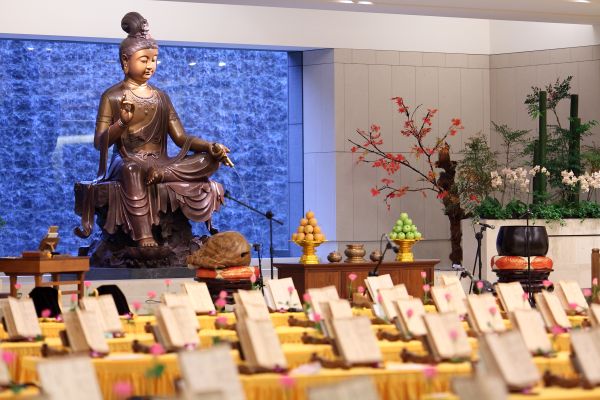
The Buddhist services in the Wish-Fulfilling Hall are mainly focused on Guan Yin Bodhisattva's approaches, including the chanting of The Universal Dharma-Door of Guanyin Bodhisattva (觀世音菩薩普門品), participating in the Great Compassion Repentance Ceremony, and the recitation of Great Compassion Mantra.
The Universal Dharma-Door of Guanyin Bodhisattva, as a chapter of The Lotus Sutra, is noticeably far-reaching, both in its impact and effects. This text, when practiced in a devout manner, would help one to understand the magnificent merits and strengths of the vows of Guanyin Bodhisattva, who contemplates the sounds of the world and manifests in various forms in an effort to liberate sentient beings from suffering.
The Great Compassion Repentance Ceremony was initially compiled during the Song dynasty, based on the Great Compassion Dharani Sutra (大悲心陀羅尼經) by Master Zhili (知禮大師)and went through a few modifications by various eminent masters. The contents of the Great Compassion Repentance Ceremony include offering incense and chanting, paying respect to the Three Jewels and Dharma-protectors, reciting the Great Compassion Mantra, repenting and making vows, and finally, taking refuge and transferring merits. It is a widely practiced ritual.
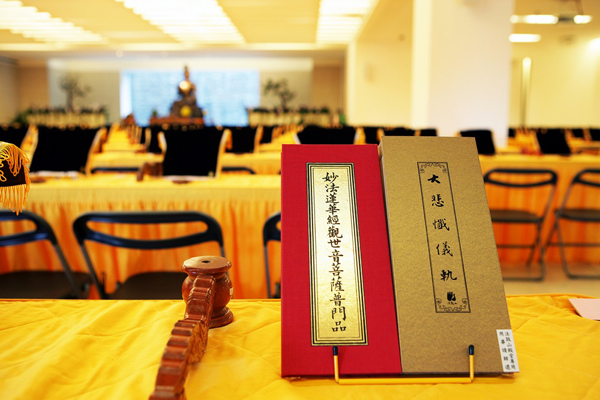
Participating in the Great Compassion Repentance Ceremony has an important function of purifying our body and mind through sincere repentance, thereby reducing our hindrances which have resulted from unwholesome actions. In actual fact, repentance and purification of our body and mind should not only take place during the ceremony. In our daily lives, we should cultivate the habit of self-reflection, repent of unwholesome deeds, and correct our mistakes as soon as we realize them. Furthermore, we should also learn from Guanyin Bodhisattva's great compassion and his aspiration to help relieve sentient beings from suffering. This is the true meaning of participating in the Great Compassion Repentance Ceremony.
As for the Great Compassion Mantra, in addition to the practice of reciting it wholeheartedly, one should also aspire to generate the Bodhi mind, as well as learn to cultivate "the mind of compassion, equanimity, purity, respect, the mind of humility, and the mind that is unscattered. "Giving rise to these mind states is the true meaning of reciting the Great Compassion Mantra.